ios gaming controller

Discover the Ultimate iOS Gaming Controllers for Immersive Play

Pick the right accessory and a quick phone session can feel like a living-room match. This guide shows how the best iOS gaming controller turns mobile play into a true console-like experience.

We test practical traits — connection type, comfort, button feel, and compatibility — so you can buy with confidence. Each pick earns its spot based on lag, portability, and long-session comfort.

In 2026 U.S. phone ownership splits between Lightning and USB‑C devices, and that shift shapes choice. Our roundup frames controllers by controls, battery and charging, ergonomics, and app experience.

Whether you want portability or full-featured design, this article lays out options, price tiers, and key features to match your play style. Read on to find a controller that makes couch time, travel, and late-night play effortless and immersive.

Key Takeaways

  • Choosing the right controller upgrades mobile gaming to a console feel.
  • We compare connection, comfort, button feel, and device compatibility.
  • Top picks are chosen for low lag, portability, and session comfort.
  • 2026 buyers should note the Lightning vs USB‑C split when choosing.
  • Evaluation focuses on controls, battery, ergonomics, and software.

Why an iOS gaming controller changes everything for mobile gaming

When a split-second input matters, glass just isn’t enough. Touch controls blur under pressure, especially in fast action or tight timing windows. Physical buttons and triggers give repeatable, tactile feedback you can trust.

Muscle memory is the big difference. Swipes and on-screen overlays vary with finger placement and sweat. A real controller restores consistent movement, aiming, and timing so you react, not guess.

That stability matters for modern play. Cloud play and Remote Play run smoother when inputs arrive cleanly. Platformers, racers, and action games on Apple Arcade-style services feel like they were built for a handheld console.

“The right mobile controller makes your iPhone feel like a portable console.”

  • Precision: firm buttons beat overlays for quick shots and tight turns.
  • Confidence: reliable triggers reduce missed inputs in heated matches.
  • Versatility: pick from compact to pro options to match travel, casual, or competitive play.

Read on and we’ll match the best options to your play style — casual, competitive, travel-first, or marathon sessions — so your next purchase feels like an upgrade, not a compromise.

What to look for before you buy a mobile controller

Before you commit, focus on the handful of parts that truly shape play. Small choices—port type, button feel, and fit—decide whether a purchase becomes your favorite or a drawer backup.

Connection types: Bluetooth vs direct port

Direct port connection feels instant and reduces latency, so inputs land with firm timing. Bluetooth offers broader compatibility and easier device swapping, but may add a touch of delay.

USB-C and pass-through charging

Look for a USB-C port with pass-through charging. It keeps play going without draining your phone and matters more than flashy extras for long sessions.

Ergonomics, size, and grip

Comfort equals performance. The right size, textured grip, and fit in your hands reduce fatigue and keep thumbs steady when matches run long.

Buttons that feel right

Good buttons mean predictable inputs: clicky buttons for tactile feedback, face buttons that don’t wobble, triggers with smooth travel, and a D-pad that doesn’t misfire.

  • Direct port: instant feel. Bluetooth: flexible use.
  • USB‑C pass-through: longer play, less battery worry.
  • Pick size and grip for long sessions, not just portability.
  • Test button travel, trigger smoothness, and D-pad accuracy before you buy.

Lightning vs USB-C iPhone compatibility in the United States right now

Port choice matters when you want your gear to work the moment you plug in. In the US market some players still use Lightning phones while newer models move to USB‑C. That split shapes which controllers are plug-and-play and which require an adapter or Bluetooth pairing.

When direct-connection makes the most sense

Pick a direct cable setup if you want the lowest latency and an instant handheld feel. A wired link turns your phone into a console-like device without wireless lag or battery juggling.

Direct connection is great for short tournaments, cloud play, or when you need predictable inputs. Confirm the phone version and case fit so the port clears camera bumps and protective covers.

When Bluetooth is the safer all-device bet

Bluetooth wins if you plan to swap between phones, tablets, Apple TV, Mac, or other devices. One wireless pad can serve multiple devices without worrying about which port is on each gadget.

Look for wide platform support and, when possible, Made for iPhone certification for easier pairing. Remember that certification can limit you to a specific port generation, so balance today’s convenience with tomorrow’s upgrades.

  • Check your phone model and case before buying.
  • Consider a usb-c port if your next phone will likely use USB‑C.
  • Weigh immediate low-latency play against multi-device flexibility.

“Choosing the right connection today means less compromise after your next upgrade.”

Hall effect joysticks and the fight against stick drift

A close-up view of advanced hall effect joysticks, prominently displayed in the foreground, showcasing their sleek ergonomic design and metallic components. The joysticks should be portrayed with detailed textures that highlight their high-tech functionality, featuring smooth, responsive movements. The middle ground should include a soft-focus background of a modern gaming console setup, illuminated with ambient LED lighting in cool blue tones, creating a tech-savvy atmosphere. The overall composition should emphasize a sense of innovation and precision, with a slightly tilted angle to create depth. The lighting should be strategically placed to enhance the reflections on the joystick surfaces, conveying a sense of high quality and durability.

Stick drift is the slow, unwanted movement of a thumbstick when you’re not touching it. It shows as tiny inputs that pull aim, nudge steering, or cause menu flicks. For shooters and racers, drift kills precision and ruins tight matches.

Hall effect sensors read position without physical contact. That reduces wear on tiny moving parts and cuts the common mechanical cause of drift. In buyer terms, paying more up front for this tech can mean fewer repairs and a longer usable life.

Why Hall effect can be a long-term value play

Hall effect parts resist abrasion because they sense magnetically, not by rubbing contacts. That keeps stick feel consistent and helps justify the added price for frequent players. In practice, better caps and grips paired with Hall sticks feel steadier over months of play.

Controllers highlighted for Hall effect thumbsticks in our research

  • Gulikit Elves 2 Pro — Hall effect joysticks, six-axis gyro, nine vibration levels; compact Bluetooth shell. Price: $50.
  • GameSir X3 Pro — Hall effect thumbsticks with detachable caps and carry case. Price: $80.
  • GameSir X4 Aileron — Hall effect sticks and tactile buttons; can be finicky to pair because of a two-part design. Price: $100.

Tradeoffs matter. Hall effect improves longevity, but pairing quirks, app quality, and comfort still shape your everyday experience. If the hardware lasts but you don’t enjoy using it, the value fades.

“Buy once, enjoy longer” — for frequent players, better stick tech can be the most satisfying upgrade you make all year.

Battery life and charging time: what “all-night play” really means

Long sessions hinge on realistic battery math, not ad slogans. How you set brightness, vibration, and wireless radios often cuts promised run time in half. Think in hours, not claims, when you plan a trip or a tournament night.

Real-world battery life callouts from tested options

Translate specs into usable expectations. The PowerA XP Ultra can deliver about 40 hours over Bluetooth and up to 60 hours in Xbox mode. Turtle Beach Atom runs near 20 hours and needs roughly two hours for full charging.

Smaller pads like the CRKD Atom top out near 10 hours and recharge via USB‑C. The GXTrust Mylox often falls well below its 12-hour claim when RGB is enabled.

How RGB lighting and wireless modes can drain power faster

RGB is fun, but costly. Keep lighting off for long sessions. Bright effects and haptics pull extra battery and reduce real-world hours fast.

  • Reality check: “All-night” depends on brightness, vibration, radios, and whether your phone is charging too.
  • Pass-through charging matters most when your phone becomes the limiting battery, not the pad.
  • Practical pick: choose longer battery for heavy play; pick fast top-ups and simple cables for travel.

“Plan for actual hours, not marketing hours.”

Best iOS gaming controller picks for immersive play

A sleek, modern iOS gaming controller displayed prominently in the foreground, showcasing its ergonomic design and vibrant LED indicators. The controller features wireless connectivity, textured grips, and multifunctional buttons, reflecting advanced gaming technology. In the middle ground, a blurred, high-resolution iPhone screen displays a popular gaming interface, emphasizing compatibility. The background is softly illuminated with a gradient of dark blues and purples, creating an immersive gaming atmosphere, reminiscent of a cozy game room environment. A subtle bokeh effect adds depth, while warm ambient lighting highlights the controller's polished finish. The overall mood is inviting and energetic, perfect for gaming enthusiasts seeking the ultimate play experience.

Not all pads are equal—some turn a phone into a true handheld machine. Below is a curated shortlist that maps top picks to play styles, budgets, and real-world use. Use this decision hub to pick fast or read on for deeper spotlights.

Backbone One — clean, console-style experience

Backbone One makes your phone feel like a compact console. Setup is instant, pickup-and-play is effortless, and the layout favors long sessions and balance.

Riot PWR iOS Xbox Edition — Lightning-friendly, wired perks

This Made for iPhone-certified option uses a Lightning cable for low latency, includes pass-through charging, and has a 3.5‑mm jack for wired audio. It supports Xbox Cloud Gaming and ships with one month of Game Pass Ultimate. The cable can feel messy, but its direct link suits long cloud sessions.

Turtle Beach Recon Cloud — Xbox Cloud Gaming and shooter help

Recon Cloud works across Android, Xbox, and Windows, and pairs well with Remote Play. It has a solid clip, programmable buttons, and Pro‑Aim to help reduce right-stick sensitivity for FPS games.

8BitDo SN30 Pro — retro design, wide support

8BitDo brings rumble, USB‑C charging, a reliable D‑pad, and multi-device support including Nintendo Switch. It’s ideal for players who love classic layouts and solid battery life.

PowerA XP Ultra — maximum versatility

PowerA offers broad platform support and long battery life (up to 40–60 hours depending on mode). The main pad feels good, though its travel-sized companion is too small for many hands.

  • Decision tip: choose Backbone One for simplicity, Riot PWR for Lightning users, Recon Cloud for shooters, 8BitDo for retro multi-device play, and PowerA for cross-platform versatility.
  • Consider: features, price, and which phone you own before buying.

“Pick the pad that fits your play style, not just the spec sheet.”

Backbone One spotlight: premium design, fast setup, and everyday portability

A Backbone One-style wraparound turns your phone into the screen and the shell into the chassis. This form factor makes setup instant and keeps pockets light. It’s a purposeful approach: the hardware feels like a handheld, not an add-on.

Why the wraparound form factor wins for commuting and quick sessions

The wraparound layout secures the phone with sturdy rails and a reliable fit. You slide the device in, and the unit becomes a single, balanced piece you can game with on the move.

That simplicity means no Bluetooth pairing or adapters when you just want a five-minute match between stops.

What to prioritize: button feel, triggers, and overall balance

Buttons should click cleanly and resist wobble; that tactile certainty makes inputs predictable across genres. Check the triggers for smooth travel and a firm reset—mushy shoulders ruin aim and rhythm.

  • Sturdy rails and a snug fit over gimmicks.
  • Satisfying face buttons that stay consistent after weeks of use.
  • Triggers with defined travel and repeatable response.

Comfort, grip, and buying intent

Balance and the right grip shape keep wrists relaxed for longer play. A well-sized unit prevents thumb strain; size should feel like an extension of your hands, not a weight to manage.

Choose a Backbone One if you want a premium design that delivers console-on-the-go comfort every day. It’s the pick for players who value instant setup, sturdy feel, and consistent inputs.

“Pick a pad that feels like it was built around your phone, and every commute becomes part of the play session.”

Xbox-style control for iPhone: Cloud Gaming-ready options

Familiar stick placement and shoulder keys turn a phone into a predictable, responsive play surface.

Xbox-style layouts suit cloud sessions because muscle memory carries over. Thumb spacing, a clear D‑pad, and shoulder triggers make inputs feel like home. That steadiness helps with long matches and fast twitch play.

Riot PWR iOS Xbox Edition: strengths and tradeoffs

Riot PWR is Made for iPhone-certified and uses a direct Lightning cable for near-instant input. Pass-through charging and a 3.5‑mm jack keep sessions long and audio simple. It even bundles a month of Game Pass Ultimate.

Tradeoff: the wired link reduces pairing fuss but adds cable clutter. If you prize low-latency reliability and simple setup, this is a solid pick.

Turtle Beach Recon Cloud: programmable upgrades for shooters

Recon Cloud leans into features: a sturdy clip, cross-platform support, programmable buttons, and Pro‑Aim to lower right-stick sensitivity on demand.

Pro‑Aim makes aiming feel calmer and more consistent in shooters by reducing twitchy stick response. Audio boosts work when plugged in, and the unit suits players who value custom buttons and versatility.

  • Pick Riot PWR for Lightning simplicity and steady sessions.
  • Pick Recon Cloud for extra features, aiming support, and multi-device support.

“Choose the pad that matches your priorities: simplicity or a richer feature set.”

See our wider platform support guide at platform support guide for device-fit tips and charging advice.

For Call of Duty-style shooters: aiming precision, triggers, and tactile feedback

High-pressure shooters demand hardware that makes precise aim feel natural. For Call Duty-style play you need repeatable inputs, clean trigger pulls, and sticks that don’t twitch under stress.

Pro-Aim and stick sensitivity control for FPS consistency

Pro-Aim-style sensitivity reduction lowers the right-stick responsiveness so tiny corrections move your reticle smoothly. Turtle Beach Recon Cloud includes this feature and also offers programmable buttons to tune inputs to your style.

Reducing sensitivity helps when targets cross your sight quickly. It steadies tracking and reduces overcorrection in tense moments.

What “responsive” really means in face buttons and shoulder triggers

Responsive is more than speed. It means low input delay, consistent actuation, and face buttons that register cleanly without extra force.

  • Repeatability: shooters need the same result every press—jump, reload, or melee must not vary.
  • Tactile feedback: click, travel, and rebound shape how fast you chain actions in fights.
  • Trigger quality: a smooth pull with a clear stop point makes semi-auto and burst timing reliable.
  • Joystick trust: solid centering and no twitch reduce aim drift during long matches.
  • Match feel to play style: the best pad disappears in your hands—pick the one that fits you.

“The right mix of sensitivity, triggers, and tactile buttons turns clutch moments into repeatable wins.”

Ultra-portable mobile controllers that disappear into your bag

A collection of ultra-portable mobile gaming controllers arranged artfully on a sleek, neutral-toned surface, showcasing their compact design. The controllers, featuring a blend of modern textures and vibrant colors, should emphasize portability, with one slightly opened to reveal its foldable nature. In the background, a stylish canvas bag is partially visible, hinting at the controllers’ ability to fit seamlessly inside. Soft, diffused lighting highlights the contours and buttons of the controllers, creating a warm and inviting atmosphere. The scene is shot from a slightly elevated angle to capture depth and detail, conveying an essence of modern gaming convenience that appeals to avid gamers. The overall mood should be energetic yet sophisticated, illustrating the fusion of technology and style.

Some pads are designed to vanish into a bag and only reappear when you need a quick match. This category values extreme portability over marathon comfort.

CRKD Atom: an emergency pocket playmate

CRKD Atom is tiny, costs about $20, and comes with a wrist strap. It delivers up to 10 hours of battery life and uses a usb-c port for fast charging.

It’s the true emergency pick: small enough to stash anywhere and ready when a short session calls. Caveat: the small size can cramp hands, and it may switch on in a pocket and drain power.

Turtle Beach Atom: fold-flat commuter design

Turtle Beach Atom runs near 20 hours, folds into two pieces, and recharges in about two hours. The split design is clever for commuters but can feel insecure without a full backplate.

Connection quirks matter: the right side must be powered separately and uses a 2.4 GHz link while your phone pairs over bluetooth. That setup can cause odd behavior in some games.

“Choose tiny only when portability beats comfort.”

  • Define the tradeoff: tiny size wins for travel, not long sessions.
  • Pick CRKD for cheap, pocket-ready backup.
  • Pick Turtle Beach for foldable convenience—accept a few connection quirks.

Split, fold, and travel: controllers built around compact design

Split and fold designs solve packing headaches, yet they change how a unit feels in hand.

Why these compact designs exist: they shrink to a pocketable size so you actually carry a pad between commutes. Travelers choose split or folding controllers to save space in bags and backpacks.

Two-piece designs and the stability tradeoff

Two-piece options free up room, but they often sacrifice rigidity. A split layout can flex, lack a solid back, or feel less confident during intense play.

Example: the Turtle Beach Atom folds neatly but can feel insecure without a supportive back. The GameSir X4 Aileron requires pairing each side and that pairing tax can be finicky.

Clamps, camera bumps, and fit challenges

Modern phones have large camera modules and thick cases. Clamps can hit bumps, making the phone sit unevenly or press into buttons.

Before you buy, check phone width, case thickness, camera module size, and whether the port or clamp design will collide with your setup.

  • Pack-first design solves travel but asks you to accept some flex.
  • Watch for pairing quirks when sides connect separately.
  • Prioritize a balance: a unit you will carry and one that still feels stable in your hands.

“The best travel pad is the one you bring — but it should feel secure enough to enjoy long sessions.”

Cooling and marathon sessions: when heat becomes the real enemy
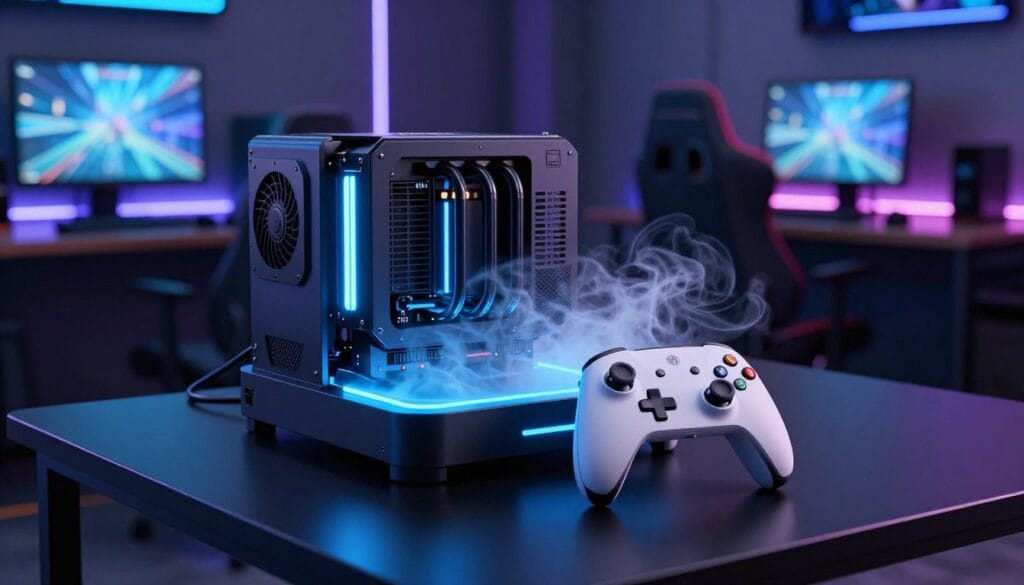
A futuristic gaming room with a focus on cooling technology, showcasing an advanced iOS gaming controller surrounded by a high-tech cooling system. In the foreground, the sleek controller is placed on a glossy black surface, illuminated by cool blue LED lights that highlight its design. The middle layer features a stylized cooling unit with visible ventilators and liquid cooling tubes, giving off an ethereal mist. In the background, a stylish gaming setup with ambient lighting creates an immersive atmosphere, emphasizing modern technology. The room is dimly lit, enhancing the cool colors, while a soft glow emanates from screens displaying gameplay. The overall mood is dynamic yet calm, reflecting the importance of cooling in prolonged gaming sessions.

When play stretches past an hour, thermal limits become the real opponent. Long, high-frame-rate sessions can warm phones enough to reduce performance and make your hands uncomfortable.

GameSir X3 Pro and its built-in fan

The GameSir X3 Pro is a pro-minded option that adds active cooling as a core feature. It cradles USB‑C phones, offers customizable grips, clicky buttons, Hall effect sticks, detachable caps, and a carry case for $80.

Its large fan delivers real cooling power, which keeps temperatures down during marathon play and helps sustain peak frame rates and steady touch response.

How to decide if active cooling is worth the tradeoff

  • Active cooling = marathon tool: best if you play long sessions or live in hot climates.
  • Tradeoffs include added bulk and fan noise that reduce portability and quiet play.
  • Software matters: the GameSir app can be buggy, which makes customization harder.

Bottom line: pick active cooling if sustained comfort, stable performance, and battery management matter to your sessions. If you prefer minimal design and light size, or you play casually, a fan may be overkill.

“Active cooling turns long sessions from a grind into a repeatable, comfortable experience.”

RGB, back paddles, and customization: features that feel like “pro controller” territory

Pro-level tweaks—like remappable paddles and refined sticks—separate hobby pads from true pro controller territory. These options must improve play, not just add flair.

Asus ROG Tessen packs programmable back paddles, pass-through charging, folding design, and RGB lighting for about $104. Its controls are responsive, but thumbsticks can feel awkward and the face buttons run noisy. Critically, this model is Android-only and won’t work with iPhones, making it a cautionary buy for many US shoppers.

GameSir X4 Aileron: ambitious feature set

The X4 Aileron ($100) brings Hall effect sticks, tactile buttons, and RGB. It aims at pro controller feel with long-term stick reliability and a satisfying button press.

Tradeoff: the two-part design needs each side paired separately. That pairing can be finicky and interrupts quick setup.

“The best customization is the one you use every session, not the one you tweak once and forget.”

  • Why back paddles matter: keep thumbs on sticks while you jump, reload, or swap weapons.
  • RGB tradeoff: stylish but it shortens battery and adds complexity.
  • Pick features that match your play: remaps, tactile buttons, and reliable hall effect sticks over pure flash.

Controllers that “just missed”: solid options with clear compromises

A sleek mobile gaming controller positioned prominently in the foreground, showcasing its ergonomic design and vibrant color accents. The controller features intuitive buttons, analog sticks, and a streamlined shape, exuding a modern aesthetic. In the middle ground, a soft focus on a stylish smartphone, displaying a popular game interface, suggests the immersive gaming experience. The background offers a subtle, blurred indoor setting with warm lighting, evoking a cozy gaming atmosphere. Incorporate a dramatic angle that highlights the controller's features, with soft, diffused light illuminating its contours. The overall mood should convey excitement and anticipation, inviting viewers to explore gaming possibilities.

These picks do useful things well, but a single tradeoff keeps each from a top recommendation.

Acer Nitro Mobile Gaming Controller

Why it appeals: folds small, uses a usb-c port, and offers pass-through charging for long sessions.

Why it missed: the feel is basic for the listed price, and cramped ergonomics hurt daily comfort for bigger hands.

Gulikit Elves 2 Pro

Why it appeals: Hall effect sticks, gyro, and nine vibration levels give strong value at about $50.

Why it missed: compact shell and membrane face buttons can tire large hands during long play.

GXTrust Mylox

Why it appeals: a comfy cradle, haptics, and RGB make it fun to use.

Why it missed: lighting cuts real battery life well below the claimed 12 hours, so practicality suffers.

PowerA Moga XP7-X Plus

Why it appeals: removable phone slot and wireless charging are clever convenience features.

Why it missed: it uses Micro USB and a modest 2,000 mAh battery, which limits run time and future proofing.

  • These controllers excel at one or two things, but each trades off comfort, battery life, or modern ports.
  • Pick one as a second-choice when a specific feature—folding, hall effect sticks, cradle comfort, or wireless charging—matters most to you.

“Choose a near-miss when one feature solves your everyday problem, not when you want an all-round winner.”

Value, price, and long-term ownership in the US market

Spend smarter: the cheapest pad can cost more over time if parts fail or app updates stop. Think beyond sticker price. Focus on comfort, repair risk, and how often you will actually play.

When paying more gets you better parts, software support, and lasting use

Higher price often buys stronger build quality, Hall effect sticks, and better shoulder switches that resist drift. Those parts reduce repairs and keep inputs consistent months later.

Paid units usually have reliable software and app support. That matters: firmware updates fix pairing quirks and improve battery behavior over time.

When budget picks win for casual play and occasional sessions

For casual games, low cost and decent battery hours can be fine. Pick simple options that feel okay, charge fast, and work out of the box.

Match spend to lifestyle: commuters may value compact size; families want multi-device support; competitive players should invest in feel and remaps.

“Buy for the hours you play, not the specs you might never use.”

  • Decide must-haves: connection type, battery, comfort, and charging.
  • Buy the option that nails those first; extras are nice, not essential.
  • Remember: good support and durable parts extend real ownership and save money long term.

Conclusion

Choose a pad that matches your play habits, and every session will feel like a deliberate upgrade.

The core takeaway: the right ios gaming controller makes your phone a true handheld system, not a compromise. Decide on the big forks: Bluetooth vs direct connection, Lightning vs USB‑C, and portability vs comfort.

Match reader needs to picks: handheld-style for everyday play, Xbox-style for cloud sessions, retro multi-device for versatility, and ultra-portable for travel. Weigh options and features against simplicity.

For long sessions, prioritize pass-through charging, stable connections, and real battery life. Choose the option that fits your phone and play habits so every mobile gaming moment feels more immersive.

FAQ

What makes a mobile gamepad worth buying over touchscreen controls?

A physical pad delivers precise input, tactile feedback, and ergonomic grip that finger-only controls can’t match. You get faster aim, reliable triggers, and button layouts built for long sessions, which helps with cloud play, Remote Play, and fast-paced shooters like Call of Duty.

Should I choose a direct-port or Bluetooth connection for my phone?

Use a direct-port connection when low latency and plug-and-play simplicity matter—especially for competitive play. Bluetooth gives broader compatibility and flexibility across devices, but expect slightly higher input lag and the need to manage pairing and battery life.

How important is a pass-through USB-C charging port?

Very. Pass-through charging keeps the phone powered during marathon sessions and prevents controller drain. It’s essential for cloud gaming, lengthy Remote Play, or any scenario where you want uninterrupted playtime.

What are Hall effect joysticks and why do they matter?

Hall effect sticks use magnetic sensing to read movement, avoiding physical contact that causes stick drift. They last longer and maintain accuracy, making them a solid long-term value for frequent players who want consistent performance.

How many hours of play should I expect from a typical portable pad?

Battery life ranges widely—compact units might offer 8–12 hours, mid-range designs 12–20 hours, and larger or accessory-rich pads can push beyond that. RGB lighting, wireless mode, and vibration all reduce runtime, so check tested real-world figures for the model you’re eyeing.

Are back paddles and programmable buttons worth it?

Yes for competitive players. Back paddles let you map common actions without moving thumbs off sticks, improving response times in shooters. Programmable buttons also help in complex titles and accessibility setups.

How do I avoid stick drift over time?

Choose controllers with Hall effect sticks, keep firmware updated, and avoid dropping or exposing the device to dust and moisture. Regular gentle cleaning around thumbsticks helps too. If drift appears, check warranty support—many brands offer repairs or replacements.

Which form factor is best for commuting and short sessions?

Compact, grab-and-go designs like the Backbone One-style or two-piece foldables work great for short breaks and commuting. They offer quick setup and a console-like feel without bulky weight, but may sacrifice some stability for portability.

Do pro-style triggers and tactile face buttons really improve FPS performance?

They do. Responsive triggers with low travel and clicky face buttons improve shot timing and tactile confirmation, which helps in fast shooters. Adjustable stick sensitivity and trigger dead-zone settings further refine aiming consistency.

Will my phone fit every clamp-style pad? What about camera bumps?

Not always. Clamps vary in maximum width and may struggle with thick cases or large camera bumps. Look for controller models that list exact phone size support and consider removing bulky cases or using adapters where available.

How much should I expect to spend for a durable, feature-rich option?

Mid-range, durable models with Hall effect sticks, good battery life, and solid software support often land in the moderate price band. Paying more usually gets better parts, longer software updates, and stronger warranties—worth it if you play daily.

Can these controllers work with other devices like Nintendo Switch or PCs?

Many modern designs offer multi-device support, but check compatibility lists. Some controllers natively support Windows, Android, and Switch; others focus on phone-first experiences. USB-C or Bluetooth connectivity often enables PC use with adapters or native pairing.

How do cooling solutions like built-in fans affect portability?

Active cooling reduces thermal throttling during marathon play but adds bulk, weight, and battery demands. Choose a fan-equipped model only if you regularly play intensive cloud streams or demanding local titles and accept the tradeoffs in portability.

What are the tradeoffs for ultra-portable split or foldable pads?

Ultra-portable pads win on size and convenience but can lose stability, button travel, and stick comfort. Two-piece designs may feel less rigid, and clamps can be less secure on larger phones. They’re ideal as a backup or travel solution, not always for pro-level play.

How does RGB lighting affect battery and performance?

RGB adds cosmetic flair but consumes extra power and can shorten wireless playtimes significantly. If runtime matters more than looks, pick a model with optional or switchable lighting, or disable RGB when playing unplugged.

Where does the Backbone One shine compared to others?

The Backbone One stands out for its slim, console-style form, instant setup, and everyday portability. It prioritizes balance, button feel, and low latency for pick-up-and-play sessions, making it a top choice for commuters and quick cloud-gaming bursts.

What should I check about software and app support before buying?

Verify firmware update frequency, companion app features (button mapping, profiles, and sensitivity settings), and OS compatibility. Strong software support extends device life and improves customization, giving more value over time.

Can cheaper controllers be good enough for casual play?

Absolutely. Budget models can deliver satisfying performance for casual titles and occasional sessions. They may lack advanced parts, Hall effect sticks, or long-term support, but they offer great value for non-competitive players.
raid finder
Raid Finder: Connect with Groups for Epic Raids
Stop missing lobbies and start joining in minutes. In today’s live-event game ecosystem, a raid finder...
pokemon go raid schedule
Conquer Battles: Your Pokémon Go Raid Schedule for June 2025
Get ready for an action-packed month with the Pokemon Go Raid Schedule for November 2024. Expect major...
how to play games on snapchat
How to Play Games on Snapchat
Quick note: Snap Games, the chat-based arcade feature, was discontinued in February 2023. Today, the...
top grossing mobile games 2024
Top Grossing Mobile Games 2024: Trends & Revenue
By 2024 the mobile gaming landscape continued to shift: Honor of Kings remained the top earner globally, generating $1.65 billion (according to Sensor Tower/FoxData), driven largely by its Chinese user base. In the US, Candy Crush Saga held its spot as a leading top grossing game, while Roblox led the UK charts — each title succeeding through proven monetization (in‑app purchases, live events) and strong live‑ops programs. Top Grossing Mobile Games 2024 reflect both regional tastes and savvy business models. China now accounts for the majority of revenue for many hits: PUBG Mobile and Genshin Impact, for example, derive more than 60% of their spending from Chinese players (source required). In April 2024 王者荣耀 ranked highly on the App Store, and Last War: Survival Game posted notable revenue gains on Google Play, underscoring how platform charts and regional strength affect overall money earned. Key TakeawaysHonor of Kings led global mobile game revenue with $1.65 billion in 2024 (verify time frame and source). Candy Crush Saga remained one of the top grossing titles in the US in 2024. Roblox secured the top spot in the UK charts for top grossing games. The Chinese market contributes over 60% of revenue for several leading games—an essential factor for publishers targeting growth. In April 2024, Last War: Survival Game showed significant revenue growth on Google Play.Overview of Top Grossing Mobile Games in 2024The mobile game market analysis for 2024 shows an industry still growing in size and complexity. More than 100 games have passed the $1 billion lifetime revenue mark (lifetime figures, source: Sensor Tower / data.ai — verify date), underscoring how large-scale hits continue to dominate the charts. Tencent remains a dominant publisher in the space, occupying 12 of the top-ranked titles and placing three games in the global top 10 for 2024 (see 2024 list). Lifetime revenue leaders include Honor of Kings (Arena of Valor), Candy Crush Saga, and PUBG Mobile — each built on business models like gacha mechanics, battle passes, and recurring in‑app purchases that drive long-term revenue. Honor of Kings has accumulated roughly $18.66 billion in lifetime revenue (verify source/date), making it the highest-grossing mobile title to date. Candy Crush Saga, launched in November 2012, has generated more than $12 billion across stores, while PUBG Mobile (launched March 2018) has exceeded $11 billion in lifetime revenue, reflecting sustained global demand. Other perennial top-earners include Monster Strike (about $11B) and Clash of Clans (over $10B); together, these titles show how varied monetization — from social mechanics to in‑game economies — produces massive lifetime returns. Below is a quick reference table of these long-running top grossing games and their release years.Game TitleRevenue (in billions)Release DateHonor of Kings (Arena of Valor) $18.66 2015Candy Crush Saga $12 2012PUBG Mobile $11+ 2018Monster Strike $11+ 2013Clash of Clans $10+ 2012This snapshot of games 2024 highlights both lifetime dominance and the range of monetization tactics that create top grossing titles. For monthly and platform-specific charts (App Store / Google Play) and a breakdown by region, see the 2024 top-grossing list below for monthly figures and charts. Highlighted Performers: Standout Titles in the Top 10As the Top Grossing Mobile Games 2024 charts show, a few standout titles continue to capture the majority of player spending and chart positions. 王者荣耀 (Honor of Kings) and Last War: Survival Game are two examples that combined strong live‑ops, regional tailoring and aggressive user acquisition to secure top grossing places across stores. 王者荣耀 (Honor of Kings) Why it works: Honor of Kings pairs frequent content drops, limited‑time events and cosmetic sales to keep ARPDAU high. According to market trackers, Honor of Kings reported roughly $80 million in player spend in Q1 2024 (verify source and scope). Its core strength remains China, where the title drives the bulk of its revenue, while localized versions and cross‑region promotions help maintain global relevance compared with other heavy hitters such as PUBG Mobile and Free Fire. Last War: Survival Game Why it works: Last War blends survival mechanics with social features and competitive progression, then amplifies reach via influencer partnerships and targeted ads. The game rose up Google Play charts in April 2024 and posted notable revenue gains thanks to these tactics (source required). Its monetization relies on timed bundles, battle passes and limited offers that convert engaged players into consistent spenders. Both Honor of Kings and Last War demonstrate how combining product‑level innovation (live ops, gacha/skins, battle passes) with strong marketing execution creates a repeatable formula for top grossing performance in 2024. For publishers aiming to reach the same spot, the playbook centers on fast content cadence, regional optimization and diversified monetization. Common Success Factors Among Top Grossing Games Top grossing mobile games generally follow a few repeatable rules: diversified monetization, strong user acquisition (UA), and live‑ops that keep players engaged. Even when overall downloads fall, the right mix of product and marketing can deliver steady revenue and high lifetime value. Monetization Strategies Successful titles combine multiple revenue streams rather than relying on one channel. Typical mechanics include:In‑app purchases (IAPs) — consumables, cosmetics, and convenience items. Gacha and randomized pulls — high ARPDAU drivers in many top grossing games. Battle passes and seasonal subscriptions — recurring revenue and retention boosts. Rewarded and interstitial ads — monetizing non‑spenders while preserving UX.Games like Royal Match and Monopoly GO! blend these tactics to keep spending consistent across cohorts. Hybrid designs that mix casual accessibility with mid‑core depth have shown measurable uplifts: certain cross‑genre titles reported roughly an 8% revenue increase after adding mid‑core progression layers (source needed — verify for specific titles). Advertising and User Acquisition Effective UA is a combination of creative ads, cross‑promotion, and influencer partnerships. Ads that highlight core loop moments and social features tend to convert better. For example, campaigns that drove in influencers and targeted creatives helped some puzzle and hyper‑casual titles soften download declines to around a 6% drop versus industry averages (confirm exact datasets). Retention and monetization improve when product features reinforce ad messaging — timed events, starter offers and social rewards make first‑time converters into repeat spenders. Below are regional revenue gains that illustrate where growth is being captured:RegionRevenue IncreaseMiddle East +8%Europe +7%Latin America +4%Quick checklist for developers aiming for top grossing placement:Design multiple monetization hooks (IAP, passes, rewarded ads). Run rapid creative tests and lean on influencers for UA lifts. Deliver frequent live‑ops and limited‑time events to drive urgency. Localize offers and UX to high‑value markets (e.g., China, APAC).In short, the best grossing games combine product innovation and disciplined marketing: diversified money models, strong UA, and live operations that keep players — and revenue — returning. Trends Shaping Mobile Gaming in 2024According to industry trackers, mobile gaming trends in 2024 are driven by shifting tech, changing player behavior, and evolving monetization models. The broader games market exceeded $187 billion in 2023 (source: verify — check whether this refers to total games or digital interactive entertainment) and is projected to approach $211 billion by 2025 in some forecasts. These top grossing projections reflect a market where mobile games capture an increasing share of player time and spend. 5G and platform capabilities Faster networks and stronger device performance are enabling richer mobile experiences. By the end of 2023 roughly 43% of smartphones supported 5G (confirm regional scope), which improves streaming, reduces latency for competitive play, and unlocks new cloud‑native features across app stores and platforms. Social features and player connection Social play is now core to retention: many new players in the US prefer titles that let them chat and play together (citations needed for the 40% figure). Nearly all top titles include in‑game chat, social invites and cross‑platform features — examples include Roblox and Pokemon Go, which prioritize social loops and user‑generated content to boost engagement. Genre shifts and monetizationHyper‑casual remains the most downloaded category in many markets, though downloads don’t always equal revenue. Puzzle games are layering mid‑core mechanics and live‑ops to increase ARPDAU and retention. In‑app purchases and subscription/battle pass models remain primary revenue drivers for top grossing games; rewarded ads monetize non‑spenders without breaking the experience.Developers are also experimenting with alternative distribution and first‑party storefronts to gain better monetization control. Overall, the industry continues to evolve rapidly — platform advances and player expectations mean publishers must iterate fast to stay in the top grossing rankings across the App Store and Google Play. Revenue Projections for Popular Games on MobileForecasts for the mobile market point to continued growth, though exact totals depend on definitions and data sources. Mobile captured nearly half of global games revenue in 2023 — roughly $90 billion by some estimates (confirm source and methodology) — and many analysts project mobile’s share to expand further through 2026–2027. For example, conservative forecasts put global games revenue near $205–211 billion by 2025–2026, with mobile representing an increasing slice of that pie. Some breakout titles illustrate how individual games can drive large sums: Monopoly GO! and Honkai: Star Rail each reported strong revenue runs in early 2024, with figures often quoted in the high hundreds of millions (e.g., $659M and $645M in certain reports — verify timeframes and sources). In January 2024 the US games market showed a notable uptick (reported +15% in select datasets), reflecting renewed spending after seasonal cycles. Regionally, Asia Pacific remains the largest market for games, with 2023 estimates around $84.1 billion; North America and Europe follow with roughly $50.6 billion and $33.6 billion respectively (confirm source dates). Projections for 2026–2027 vary across forecasters — some show North America approaching $118 billion in broader digital entertainment measures while other region totals are reported differently; ensure you reference the original model (games vs. interactive entertainment) when citing these numbers.Revenue Region2023 RevenueProjected 2027 RevenueNorth America $50.6 Billion $118 Billion (check source & scope)Europe $33.6 Billion $205 Billion (likely broader market figure — verify)Asia Pacific $84.1 Billion Unknown / varies by forecastSmaller regions also show growth: the MENA‑3 market is forecast by some firms to reach about $2.65 billion by 2027. At the same time, publishers note mixed sentiment in parts of Europe — e.g., a small share of German gaming businesses expecting growth in 2024 — underscoring regional variance. How to read these projections: always check whether a figure refers specifically to mobile, to games overall, or to the broader digital entertainment market; verify whether numbers are retail revenue, consumer spend, or operator/platform receipts. For publishers and app store strategists, the takeaway is clear: mobile remains the fastest‑growing channel for player engagement and revenue, so platform strategy (App Store vs. Google Play), localization, and live‑ops investments should be prioritized as companies plan for the next several years. Top Mobile Game Developers in 2024The mobile games ecosystem in 2024 is driven by a mix of legacy publishers and fast-moving newcomers. Leading publishers — from Tencent and Supercell to Playrix and EA Mobile — continue experimenting with live‑ops, IP licensing, and platform strategies (App Store vs. Google Play) to maximize revenue and reach. Industry trackers report massive annual download volumes (verify exact figure for “300 billion” downloads in 2023), with games accounting for the majority of that activity and driving most store grossing charts. Recent breakout hits such as Monopoly Go! and Wood Nuts & Bolts Puzzle rose quickly in 2023–2024, showing how timely launches and strong UA can vault new titles into top positions. Successful developers combine intuitive core loops with aggressive live‑ops and monetization mechanics to turn downloads into sustained spend. Major publisher highlights:DeveloperKey TitlesKey AchievementsEA Mobile FIFA Mobile, The Sims Mobile Ported major IPs and developed standalone mobile offers for broad audiencesNiantic Pokemon Go, Harry Potter: Wizards Unite Built massive AR/social experiences with millions of active playersNintendo Mario Kart Tour Top casual mobile hit leveraging a global IPNCSOFT Lineage W High revenue performer on Google Play in select markets (verify region/timeframe)SciPlay Monopoly Slots, Bingo Showdown Focused on casino/bingo verticals with steady monetizationWarner Bros. Entertainment DC Batman, Wizarding World Leveraged film and franchise IP to drive installs and in‑app spendCase Studies: Successful Games and Their StrategiesThese short case studies show how product design, IP, and monetization combine to create top grossing games. Monopoly Go Monopoly Go leveraged a globally recognized IP plus frequent events and starter bundles to rapidly convert new users into paying players. Strategy takeaway: IP + frequent live events = higher initial conversion and retention. Royal Match Royal Match stands out in the puzzle category by pairing polished visuals with a layered progression system and well‑timed offers. Strategy takeaway: superior UX and progression loops increase ARPDAU in puzzle titles. Legend of Mushroom Legend of Mushroom combined RPG progression with strategy mechanics and recurring events to boost engagement. It monetizes through IAPs and optional subscriptions. Strategy takeaway: hybrid mechanics can expand audience while lifting revenue per user. Top Grossing Mobile Games 2024 In 2024 the top grossing games combined strong monetization with high engagement. Honor of Kings led earnings in key months, reporting roughly $174.6 million in the cited period (confirm source and timeframe). Monopoly GO! posted a major year‑over‑year surge to about $146.5 million, while Brawl Stars also climbed to the high tens of millions with a strong monthly increase — all examples of how live‑ops and event-driven monetization drive grossing positions. Platform snapshots for April 2024 show the market still generating billions: reported apps store revenue for the month approached $6.2 billion in some datasets, while downloads remained large — Pizza Ready! led downloads in April with about 26.4 million installs, followed by Roblox at ~17.9 million (verify source attribution). Call of Duty: Warzone Mobile generated roughly $5 million in revenue on its measured month with ~6.4 million downloads in that period, illustrating how downloads and revenue don’t always move in sync.GameDownloads (April 2024)Revenue (April 2024)Revenue Increase (Y/Y)Honor of Kings Not specified $174.6m (verify) -5.4%Monopoly GO! Not specified $146.5m (verify) +1,170%Brawl Stars Not specified $84.3m (verify) +810.6%Call of Duty: Warzone Mobile 6.4m $5m Not specifiedPizza Ready! 26.4m Not specified +72.5%Roblox 17.9m Not specified Not specifiedApril also saw very high install volumes overall (figures vary by tracker — some report nearly five billion game downloads globally for the month; confirm which dataset), while publisher revenues such as Supercell’s showed strong year‑over‑year gains in certain months (e.g., reported $168 million in a cited period). The takeaway: store rankings (App Store and Google Play) matter for visibility, but a title’s monetization design — IAPs, passes, limited offers — determines top grossing outcomes. Conclusion The mobile games industry remains robust in 2024. App‑store activity and downloads continue at scale — industry estimates cite roughly 300 billion app downloads in 2023 with games representing the majority (verify source and definition). Android tends to capture the larger share of installs while iOS often drives higher per‑user spend for top grossing titles like Genshin Impact, Candy Crush Saga and Royal Match. Long‑running franchises such as Honor of Kings, Candy Crush and PUBG Mobile have amassed multibillion-dollar lifetime revenue totals (e.g., Honor of Kings cited near $18.66B — confirm latest figures). Newer hits and niche titles can still break through with the right mix of IP, live‑ops and UA, so publishers should prioritize regional strategy, platform optimization (App Store vs. store google play) and diversified monetization to reach top grossing spots. Studying these rankings and revenue drivers gives developers clear levers to improve performance: iterate on live‑ops cadence, test offers aggressively, and localize both product and UA to high‑value markets.FAQWhat are the top-grossing mobile games of 2024? Top earners in 2024 included 王者荣耀 (Honor of Kings), Last War: Survival Game, Monopoly Go, Royal Match and several enduring franchises such as Candy Crush Saga — rankings vary by month and platform, so check the latest App Store and Google Play charts (source: market trackers). What drives success for top grossing games? Key drivers are diversified monetization (IAPs, battle passes, rewarded ads), frequent live‑ops/events, strong UA creatives, and regional optimization. Technology (cloud, AR, 5G) and social features also boost retention and spend. How did specific games perform month‑on‑month in 2024? Market trackers such as Sensor Tower / data.ai / FoxData report month‑by‑month changes; titles like Honor of Kings and Last War posted steady revenue across multiple months. Always verify figures against the original dataset for precise month ranges. Which stores and platforms matter most? Both App Store and Google Play are essential — App Store often drives higher iOS revenue per user, while Google Play captures a larger volume of installs globally. Publisher strategy should optimize for both stores....
Competitive Mobile Games
Master Competitive Mobile Games in 2025: Tips & Strategies
Posted by John Luna on Jun 13, 2025 at 11:00 AM EST. This guide sets the stage for serious play in 2025....

Newsletter Updates

Enter your email address below and subscribe to our newsletter

Leave a Reply

Your email address will not be published. Required fields are marked *